
Why Small Kitchen Remodels Deliver the Highest ROI of Any Interior Project
According to the 2025 Cost vs. Value Report published by Zonda, a minor midrange kitchen remodel returns 112.9% of its cost at resale. It is the only interior home improvement project in the national top five for ROI, holding that position for the second consecutive year. The defined scope covers cabinet refacing, new countertops, updated appliances, a new sink and faucet, resilient flooring replacement, and a trim repaint. No walls moved. No layout changes. No custom cabinetry.
The average national job cost for this scope is $28,458, which produces an estimated $32,141 in resale value: a net gain of $3,683. That gap is where the return comes from. Buyers see an updated kitchen, and the renovation cost stays well below what it would take to gut the space.
The contrast figures are starker. A major midrange kitchen remodel averaging $82,793 returns approximately 51% at resale. An upscale gut renovation averaging $164,104 returns roughly 36%. Spending three times more on your kitchen does not produce three times the return. It produces a fraction of it.
Smaller remodels outperform for a structural reason. A targeted cosmetic update appeals to the broadest possible buyer pool across all price points. A luxury renovation narrows that pool to buyers who specifically want that finish level in that market. Diminishing returns kick in hard above $40,000–$50,000 in kitchen spending, a threshold identified by senior editors at Remodeling Magazine and corroborated by Kitchen Solvers’ 2026 national market analysis.
Before committing to any scope, use the Kitchen Renovation Cost Calculator to see exactly where your project sits on the ROI curve, and whether you are approaching the point where additional spending stops adding value.
| Remodel Scope | Typical Cost | Avg. National ROI | Best For |
|---|---|---|---|
| Minor / cosmetic | $9,000–$28,000 | 113% (Zonda 2025)* | Pre-sale, budget-constrained owners |
| Major midrange | $30,000–$55,000 | ~51% | Long-term owners, full upgrade |
| Upscale gut renovation | $60,000–$100,000+ | ~36% | Luxury markets only |
113% ROI applies to the full minor midrange scope averaging $28,458. Limited cosmetic refreshes at the low end of this range will return a lower absolute dollar gain.
The financial case is clear, but it is not the only one. The NAR/NARI 2025 Remodeling Impact Report found that 64% of homeowners report a greater desire to be at home after completing a renovation project — a result that kitchen upgrades consistently drive, given they earn one of the highest satisfaction scores of any project type. For homeowners who plan to stay in the property long-term, that personal return compounds every day. The financial ROI at resale is the ceiling; the daily quality-of-life gain starts immediately.
Is Your Kitchen Actually ‘Small’? The Square Footage Thresholds That Set Your Budget
That quality-of-life gain is worth protecting. Knowing exactly which cost category your kitchen falls into is the first step, because misreading your kitchen’s size means misreading every cost figure you encounter.
The industry-standard threshold is under 100 square feet for a small kitchen. A 10×10 kitchen (the benchmark layout used by cabinet manufacturers and cost estimators nationally) sits at exactly 100 square feet with 20–25 linear feet of cabinetry. Kitchens from 100 to 200 square feet are classified as medium. Anything above 200 square feet is large.
Those thresholds translate directly into cost bands. The 2026 U.S. Houzz Kitchen Trends Study (n=1,780 homeowners) found that a major remodel of a smaller kitchen carries a $46,000 median spend, compared to $75,000 for a larger kitchen. The NKBA’s 2025 data puts medium kitchen remodels at $71,159 on average and large kitchens at $137,228. A small kitchen owner is not facing those numbers.
| Kitchen Size | Sq Ft | 2026 Cost Range | Scope Ceiling |
|---|---|---|---|
| Small (this guide) | Under 100 sq ft | $9,000–$30,000 | Cabinet refacing through full gut |
| Medium | 100–200 sq ft | $18,000–$55,000 | Full remodel with layout changes |
| Large | 200+ sq ft | $45,000–$137,000+ | Custom and structural work |
Per-square-foot costs nationally run $150–$500, with wide regional spread. Regional contractor data puts West Coast full remodels at $75,000–$100,000, the Midwest at $30,000–$50,000, and the Southeast at $15,000–$30,000. The 10×10 benchmark kitchen specifically runs $18,000–$50,000 depending on material tier, with a realistic starting point for most small kitchen cosmetic work at $9,000. The 2026 Houzz Renovation Plans Report confirms that 75% of homeowners expect to spend at least $10,000, which aligns with the floor of what produces a meaningful result.
Size classification also changes which decisions matter most. One data point makes this clear: 68% of renovating homeowners kept the same kitchen footprint after their remodel, according to Houzz 2026, up four percentage points year over year. Staying within your existing footprint is not a concession. It is what most homeowners do, and the layout choices available within that footprint are where real cost efficiency is won or lost.
The 4 Small Kitchen Layouts Ranked by Cost Efficiency
That footprint decision is the highest-leverage call you make. Within the same 80 square feet, the layout you choose determines whether your remodel costs $10,000 or $35,000, before a single cabinet is selected. The four layouts available to small kitchen owners are not interchangeable. They differ by several thousand dollars in base cost, and that gap widens the moment plumbing or walls move.
Layout selection is a cost decision before it is a design decision. The rankings below reflect total installed cost for a small kitchen remodel, not aesthetics. The Guide to Modern Kitchen Remodel Ideas covers design direction in depth; this section covers what each layout actually costs.
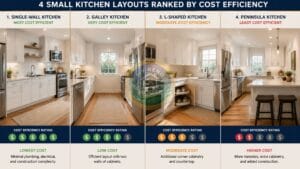
Single-Wall (I-Shaped): $10,000–$25,000
All cabinetry, plumbing, and appliances run along one wall. No cross-wall plumbing routing, no second-wall labor, no corner hardware. For kitchens under 60–80 square feet — studios, apartments, open-plan homes where the kitchen shares a wall with living space — this is the lowest-cost configuration available. Per-square-foot costs run $140–$250 because fixed costs don’t compress with size, but eliminating second-wall and corner complexity keeps the total project within reach. The trade-off is counter space: vertical storage solutions are not optional in a single-wall kitchen. They are structural necessities.
Galley (Two-Wall Corridor): $16,200–$31,600
The galley places appliances and cabinetry on two parallel walls with a corridor between them. According to Angi’s 2026 cost data, the national range is $16,200–$31,600 at an average of $150 per square foot. The cost premium over single-wall only materializes if plumbing has to cross to the second wall. When both runs already exist, this is a straight swap with no structural cost premium. The NKBA planning guidelines set 42 inches as the minimum functional aisle width for a single-cook galley and 48 inches for two-cook households. Below 42 inches, the layout fails regardless of finish quality. Total room width should fall between 7 and 10 feet. Wider than 10 feet, and the galley’s efficiency advantage starts dissolving into wasted corridor space.
L-Shaped: $20,000–$35,000
The L-shaped layout uses two perpendicular walls and works in spaces as small as 100 square feet. It is the most adaptable small kitchen configuration: it supports two-cook workflows, integrates naturally with open-concept living areas, and accommodates a small island or breakfast table when at least 12 feet of clear floor space exists. The moderate cost premium over the galley comes almost entirely from one line item: corner storage hardware. Blind-corner pull-out systems run $400–$1,200 installed. Budget diagonal cabinets run 30–40% less but create dead storage that most homeowners stop using within a year. The corner is not optional. It is where the L-shape earns or wastes its cost premium.
Peninsula: $20,000–$35,000 base + $1,500–$5,000 peninsula addition
A peninsula anchors to an existing wall or cabinet run, adding counter space, casual seating, and a room divider without the floor-space demand of a freestanding island. Angi’s 2026 data puts peninsula installation at approximately $3,100 on average, compared to $900–$6,500 for a standalone island. The cost advantage comes from anchoring one end to existing structure, which eliminates finished cabinetry on that side. The 2026 U.S. Houzz Kitchen Trends Study found that 58% of renovating homeowners add or update an island or peninsula, and the peninsula is increasingly the choice where a full island simply won’t fit. Minimum functional length is 4 feet; below that it reads as an obstacle rather than a workspace. Adding a sink or cooktop to the peninsula breaks the cost model. Plumbing and electrical additions push the total peninsula cost to $5,000–$15,000+.
| Layout | Best For | Total Remodel Range | Key Cost Driver |
|---|---|---|---|
| Single-wall | Under 60–80 sq ft; studios; apartments | $10,000–$25,000 | Linear cabinetry only; no corner hardware |
| Galley | Narrow spaces; solo cooks; max efficiency | $16,200–$31,600 | Second-wall run; no premium if plumbing stays |
| L-shaped | 60–100 sq ft; open-concept; two-cook | $20,000–$35,000 | Corner hardware ($400–$1,200 installed) |
| Peninsula | Open-concept; entertaining; seating needed | $20,000–$35,000 + $1,500–$5,000 addition | Structural anchoring; countertop extension |
Regional variance: Northeast and West Coast projects run 25–45% above these national medians; South at median; Midwest 5–10% below.
The Hidden Cost of Moving a Wall or Plumbing Line
Every layout decision above assumes you keep existing plumbing and electrical in place. The moment any of that moves, costs escalate faster than most homeowners anticipate.
Keeping your existing footprint saves 20–40% of total remodel cost, according to data from NAHB remodeling surveys and 2026 binding-bid data across 40+ US metros. The per-trade cost of changing that decision:
- Moving a kitchen sink: $500 for a minor same-wall shift; $1,000–$3,500 for a standard relocation; $5,000+ for moving to a new wall or island
- Plumbing relocation: $935–$1,138 per piping run (Homewyse, citing BLS labor data, May 2026)
- Non-load-bearing wall removal: $500–$3,000 total project cost (Angi 2026)
- Load-bearing wall removal: $3,000–$10,000+ nationally; $5,000–$15,000 in higher-cost metros. Requires a structural engineer fee (~$500), temporary supports, a new beam, permits, and inspections
- Permit costs for structural work: $200–$2,000 depending on jurisdiction
The practical rule is simple: don’t move plumbing in a small kitchen unless the current position makes the layout functionally unusable. On a $25,000 small kitchen remodel, a single sink relocation can consume 8–14% of the entire budget. That is before a cabinet, countertop, or appliance is touched.
Cabinet Options for Small Kitchens: Stock vs. Semi-Custom vs. Custom (2026 Cost Breakdown)
Budget pressure on cabinets starts where sink relocation decisions end. Both pull from the same pool. Cabinetry accounts for 30–40% of a total kitchen remodel budget in a fully installed project, per Angi’s 2026 cost data. That means on a $25,000 small kitchen remodel, you are allocating $7,500–$10,000 to cabinets before countertops, flooring, or appliances are factored in. For a small kitchen with approximately 15 linear feet of cabinetry, Angi’s 2026 small kitchen guide puts the total installed cabinet cost at $1,900–$9,400. The tier you select (not the size of your kitchen) determines where in that range you land.
84% of renovating homeowners upgrade cabinets as part of their kitchen project, according to the 2026 U.S. Houzz Kitchen Trends Study. The question is not whether to address cabinets. It is which tier to use.
Evaluate cabinet options from least cost to most, not most to least. Most small kitchen owners find their answer in the first two tiers.
| Tier | Cost Per Linear Ft (Installed) | Lead Time | Best For | 2026 Tariff Impact |
|---|---|---|---|---|
| Cabinet refacing (keep boxes) | $4,484–$10,586 total project | 1–2 weeks | Sound boxes, same layout, budget-constrained | None — domestic labor only |
| Stock (off-the-shelf) | $100–$300/linear ft | Immediate | Fast timelines, tight budgets | Elevated — most stock lines are imported |
| Semi-custom | $150–$650/linear ft | 4–8 weeks | Best value tier in 2026; domestic options available | Moderate — gap vs. imported budget has narrowed |
| Full custom | $500–$1,200+/linear ft | 10–16 weeks | Non-standard dimensions, unique layouts | Low — primarily domestic production |
Per-linear-foot figures from HomeLight, SimplyWise, Highland Cabinetry, and KitchenSearch 2026 data. No Tier 1 source (NKBA, Houzz, Zonda) publishes installed per-linear-foot cabinet pricing in public reports.
Start with refacing if your cabinet boxes are structurally sound. Refacing keeps existing boxes and replaces only doors, drawer fronts, and hardware. Angi’s 2026 resurfacing guide puts the total project cost at $4,484–$10,586 (average: $7,232), a fraction of full replacement cost, with a 1–2 week installation window. Industry analysis citing Remodeling Magazine and NAR data attributes cabinet refacing with ROI in the 72–96% range as a standalone upgrade. The minor kitchen remodel scope that produces Zonda’s 112.9% national ROI uses refacing as its primary cabinet component.
The 2026 tariff environment shifts the stock vs. semi-custom calculation. A 25% tariff on imported kitchen cabinets (imposed in 2025 and still in effect through the end of 2026) has raised prices on budget imported stock lines while domestic semi-custom manufacturers have not proportionally increased their prices. The cost gap between entry-level imported stock and domestic semi-custom has narrowed significantly. A planned increase to 50% in January 2027 reinforces the case for locking in cabinet pricing before year-end if your project timeline allows it.
Full custom at $500–$1,200+ per linear foot makes financial sense in one specific scenario: non-standard dimensions where no stock or semi-custom option fits without costly filler panels or structural modification. For most small kitchen owners working within existing footprints and standard wall configurations, custom cabinetry returns less at resale than the cost premium it adds.
On color and finish direction, 59% of NKBA professionals say wood grain is now surpassing painted cabinets in popularity, the first time in the organization’s tracking history. White oak leads wood preferences at 51% of professionals surveyed. Among consumers, the 2026 Houzz study shows wood cabinets at 29% adoption (up 6 points year over year), overtaking white at 28% for the first time. The broader shift is toward warm neutrals such as putty, mushroom, and oatmeal rather than stark white. Separately, 69% of NKBA professionals identify flat/slab door styles as gaining adoption, consistent with the minimalist direction across the category. For small kitchens specifically, lighter upper tones with a contrasting darker lower cabinet (chosen by 24% of renovating homeowners) visually anchor the space without making it feel compressed.
Budget for specialty storage in any tier you choose. 94% of renovated kitchens now include pullout waste bins, tray drawers, and spice organizers as standard. It is no longer an upgrade.
Countertop Materials for Small Kitchens: Cost Per Sq Ft and Durability Rankings (2026)
Cabinet selection locks in roughly 30–40% of your budget. The countertop decision consumes a significant share of what remains. It is also where small kitchen owners hold a cost advantage that most guides miss.
91% of renovating homeowners upgrade countertops, making it the single most commonly replaced kitchen element, according to the 2026 U.S. Houzz Kitchen Trends Study. The national average for a full countertop installation is $3,143, with a typical range of $1,852–$4,462 (Angi 2026). In a large kitchen with 60–80 square feet of counter surface, premium materials escalate quickly. In a small kitchen with 30–35 square feet, they often don’t.
Editorial calculation: A 35-sq-ft small kitchen counter surface at the quartz national average of $88/sq ft installed = approximately $3,080 total. Premium material. Mid-range budget. This math is specific to small kitchens and rarely appears in standard countertop guides.

| Material | Cost Per Sq Ft (Installed) | Maintenance | Heat Resistance | Best For Small Kitchens |
|---|---|---|---|---|
| Quartz | $60–$110 | Zero-maintenance; non-porous | Moderate (use trivets) | Most popular; NKBA benchmark for high-use zones |
| Granite | $80–$150 | Annual sealing required | High | Natural variation; strong resale signal in all markets |
| Porcelain slab | $65–$120 | Zero-maintenance; UV-safe | Superior (cast-iron safe) | Luxury look; slab backsplash continuity |
| Butcher block | $50–$100 | Oil sealing; renewable | Low (use trivets) | Warmth; renewability; small prep zones and islands |
| Laminate (2026 profiles) | From $15 | Wipe-clean | Low | Budget tier; improved durability vs. prior generations |
Quartz and granite figures: HomeGuide 2026; Homewyse BLS-derived May 2026. Butcher block: HomeGuide, Angi, SlabWise fabricator survey 2026. Porcelain slab: Angi 2026. No Tier 1 source (NKBA, Houzz, Zonda) publishes installed per-sq-ft countertop pricing in public reports.
Quartz holds the largest consumer market share at 32% of renovating homeowners per Houzz 2026, and 78% of NKBA design professionals expect it to remain the top choice for at least three more years. At the national average of $88/sq ft (HomeAdvisor/HomeGuide mid-market data), a full small kitchen countertop installation runs $2,640–$3,080 for a 30–35 sq ft surface. Note that full installed costs including complex fabrication run $120–$157 per square foot per Homewyse’s BLS-derived May 2026 data, which explains why mid-market quartz and granite sit in overlapping price ranges at the professional installation tier. For most small kitchens with standard countertop configurations, the $88 mid-market average is the most applicable benchmark.
Granite’s cost range has shifted upward in 2026. Homewyse’s BLS-derived May 2026 calculator puts granite installation at $96.58–$141 per square foot for standard residential projects. HomeGuide confirms $80–$150 per square foot installed as the national average, with entry-level granite starting near $50 per square foot in competitive markets for standard colors. Among NKBA professionals, granite ranks third at 43% and is declining as quartzite (62%) gains ground for its superior hardness and lower maintenance requirements.
Butcher block has found its strongest use case as a contrast island or peninsula surface rather than a primary countertop. The 2026 Houzz study shows it surging 13 points year over year to 44% of homeowners who choose a different material on their island. Installed cost runs $50–$100 per square foot (Angi, HomeGuide, Homewyse 2026), with the national average landing near $58 per square foot for standard hardwoods per SlabWise’s fabricator survey from March 2026. Annual maintenance runs $10–$50 for oiling and resealing.
On ROI, the clearest verified figure comes from Opendoor citing Cost vs. Value 2025 data: countertop replacement as a standalone project returns roughly 60–80 cents on the dollar. As part of the full minor kitchen remodel bundle, countertops are one of the highest-value components driving the 113% composite national ROI. A $3,000 quartz countertop upgrade in a small kitchen returns approximately $1,800–$2,400 in measurable resale value. That figure does not include the buyer-perception premium that updated countertops consistently produce on days-on-market and offer strength.
One application specific to small kitchens: 28% of kitchen renovators now choose slab-style backsplashes versus 72% tile, with engineered quartz leading at 39% of slab selections and quartzite second at 33% (Houzz 2026). Extending countertop material up the wall as a continuous slab eliminates the visual break between counter and backsplash. In a kitchen under 100 square feet, that continuity creates perceived depth without adding a single square foot. 75% of NKBA professionals identify slab backsplashes as gaining adoption, making this a professionally validated direction rather than a stylistic preference.
The 8 Highest-ROI Small Kitchen Remodel Ideas Ranked by Cost-Per-Impact
That slab backsplash runs $65–$120 per square foot installed. The hardware swap in idea #6 below costs $300 total. Both appear on this list because cost-per-impact is not the same as cost-per-dollar. It is the ratio of visual and financial return produced by each dollar spent. This section ranks eight upgrades by that ratio.
The 2026 Houzz Kitchen Trends Study’s upgrade frequency data tells you precisely what buyers notice and what they expect to see: 91% of renovators upgrade countertops, 85% upgrade backsplashes and sinks, 84% upgrade cabinets, 82% upgrade faucets, 78% upgrade lighting, and 65% upgrade flooring. Items near the top of that ladder carry more buyer-visibility weight in a pre-sale context. Items further down carry more cost-efficiency weight for long-term owners. The ranking below balances both signals.
Ideas 1–3 together constitute a complete cosmetic remodel for under $18,000. Ideas 4–8 are finishing layers. Each adds measurable value independently but delivers the most impact when built on top of the first three. If budget requires stopping, stop after idea #3. For sequencing these upgrades with the correct trade order so no layer requires rework, see the Kitchen Remodel Timeline for U.S. Homeowners.
| # | Upgrade | Cost Range | ROI / Impact | Permit? | DIY? |
|---|---|---|---|---|---|
| 1 | Cabinet refacing | $4,000–$9,000 (small kitchen) | 70–96% ROI; 78% less than full replacement | No | Partial |
| 2 | Countertop swap (laminate to quartz) | $3,000–$8,000 | 60–80% standalone ROI (Opendoor/CvV 2025); #1 buyer-noticed upgrade | No | No — fabrication required |
| 3 | Under-cabinet + recessed lighting | $400–$1,500 | 70–85% ROI; highest visual-impact-per-dollar in small kitchen | No (existing circuit) | Yes |
| 4 | Backsplash installation | $480–$1,500 (tile); up to $3,500 premium materials | 85% of renovators upgrade; high buyer visibility | No | Yes (tile) |
| 5 | LVP flooring replacement | $1,500–$4,000 installed | 94% of NKBA pros cite wood as top flooring; LVP delivers same buyer perception | No | Yes (click-lock) |
| 6 | Hardware + faucet swap | $300–$1,200 | 90% ROI; fastest ROI per hour; transforms cabinet appearance with zero structural work | No | Yes |
| 7 | Full-height backsplash (to ceiling) | $1,500–$4,500* | 75% of NKBA pros identify slab backsplashes as gaining adoption; creates visual height | No | No — fabrication required |
| 8 | Cabinet painting | $425–$940 pro (small kitchen) / $200–$500 DIY | 70–80% ROI; Remodeling Magazine CvV 2026 | No | Yes |
Full-height slab backsplash: derived editorial estimate based on verified Angi 2026 component pricing (tile: $32.95–$56.21/sq ft per Homewyse BLS; slab: $65–$120/sq ft per Angi). No single source publishes this as a standalone project category.
Cabinet Refacing ($4,000–$9,000 for Small Kitchens)
Refacing keeps existing cabinet boxes and replaces only doors, drawer fronts, and hardware. For a small kitchen with 10–15 linear feet of cabinetry, Angi’s 2026 resurfacing data confirms costs in the $4,000–$9,000 range, with the national average across all kitchen sizes at $7,232. As of 2026, refacing costs 78% less than full cabinet replacement on average (Modernize 2026). ROI is confirmed at 70–96% by Remodeling Magazine’s 2026 Cost vs. Value Report and NAR Remodeling Impact Research, nearly double the 50–65% return on full replacement. Installation window: 1–2 weeks.
Countertop Swap: Laminate to Quartz ($3,000–$8,000)
91% of renovating homeowners replace countertops, making it the single most common and most buyer-visible upgrade per Houzz 2026. Standalone countertop replacement returns 60–80 cents on the dollar, according to Opendoor citing Zonda Cost vs. Value 2025 data. For a 30–35 sq ft small kitchen surface at the $88/sq ft quartz national average, total installed cost runs approximately $3,080, the low end of this range before removal of existing laminate ($200–$600 additional). No fabrication can be DIY’d; professional cutting and templating are required.
Under-Cabinet and Recessed Lighting ($400–$1,500)
The NKBA 2026 Kitchen Trends Report identifies natural lighting (95%), quality lighting (93%), and task lighting (92%) as the top three kitchen design priorities among homeowners, above appliances, storage, or materials. Under-cabinet lights are specified by 82% of NKBA design professionals. CabinetSelect.com, citing Remodeling Magazine 2026 data, confirms a comprehensive lighting update returns 70–85% ROI at a project cost of $1,200–$2,500. Under-cabinet LEDs on an existing circuit require no permit and are fully DIY-eligible. They make outdated cabinets look current rather than neglected.
Backsplash Installation ($480–$1,500 for Standard Tile; Up to $3,500 for Premium Materials)
85% of renovating homeowners replace their backsplash per Houzz 2026, tied with sinks as the second most commonly upgraded element after countertops. Angi’s 2026 backsplash installation guide confirms the national average at $1,000 for a 35-sq-ft kitchen backsplash, with a standard professional range of $480–$1,500. Homewyse’s BLS-derived May 2026 calculator confirms $32.95–$56.21 per square foot installed. Standard ceramic or porcelain tile is fully DIY-eligible; no permit required. A $200 weekend DIY tile installation is visually indistinguishable from a $900 professional installation when substrate prep is done correctly.
LVP Flooring Replacement ($1,500–$4,000 Installed)
94% of NKBA professionals cite wood as the most popular kitchen flooring choice in 2026. LVP delivers near-identical buyer perception at $4–$16 per square foot installed, compared to $8–$25 for hardwood. For a small kitchen under 80 square feet, total LVP material and installation runs $320–$1,280 at national average rates. The $1,500 floor in the range accounts for professional installation and removal of existing flooring. Click-lock floating installation requires no adhesive, no permit, and is confirmed DIY-eligible in most US jurisdictions.
Hardware and Faucet Swap ($300–$1,200)
Angi 2026 confirms cabinet hardware installation averages $300 total and kitchen faucet installation averages $262 professionally installed. Combined budget is under $600 for most small kitchens. 82% of renovating homeowners upgrade their faucet per Houzz 2026, making it a buyer expectation rather than a differentiator. CabinetSelect.com, citing Remodeling Magazine 2026, confirms fresh hardware paired with paint delivers 90% ROI, the highest confirmed ROI percentage of any single-day upgrade on this list. No permit required for same-position faucet and hardware replacement.
Full-Height Backsplash to Ceiling ($1,500–$4,500)
Extending countertop slab material from standard backsplash height to the ceiling eliminates the visual cut-off point that compresses small kitchens vertically. 75% of NKBA professionals identify slab backsplashes as gaining adoption in 2026. This is not a DIY project: porcelain or quartz slab above countertop height requires professional templating, fabrication, and adhesive setting. Derived cost estimate: porcelain slab at $32.95–$56.21/sq ft (Homewyse BLS May 2026) across 20–30 additional sq ft of wall coverage = $659–$1,686 for tile; quartz/porcelain slab at $65–$120/sq ft produces $1,300–$3,600. The $1,500–$4,500 total range accounts for fabrication complexity and edge finishing.
Cabinet Painting ($425–$940 Professional for Small Kitchens / $200–$500 DIY)
Angi’s 2026 Cabinet Painting Cost guide confirms professional painting at $425–$1,465 nationally (national average $940), with small kitchens at the $425–$940 end of that range based on 10–15 linear feet of cabinetry. Remodeling Magazine’s 2026 Cost vs. Value data, cited by CabinetSelect.com, confirms professional cabinet painting delivers 70–80% ROI, adding $560–$960 in resale value for every $800–$1,200 spent. A separate 2026 real estate analysis (costtorenovate.com) confirms hardware and cabinet paint together achieve 90% ROI, making the combination the highest-return pairing per dollar on this list when refacing is not in budget. White and warm neutral tones remain the strongest resale color choices; professionally painted cabinets last 8–15 years with proper prep and finish coat.
Small Kitchen Storage Ideas: Vertical and Space Maximization Strategies
Those professionally painted cabinets last 8–15 years. The storage systems below last the life of the kitchen. Unlike paint, they produce functional square footage rather than visual improvement. That distinction matters most in kitchens under 100 square feet, where every square foot of usable space has to earn its keep.
72% of NKBA professionals identify enhanced storage as gaining traction in 2026. The NKBA’s own year-in-review explicitly categorizes storage as “a lifestyle solution” rather than a functional afterthought. With more homeowners choosing to renovate instead of move, organized, space-maximizing designs have become a high priority, as confirmed by the 2026 Best of Houzz awards analysis across 70 million homeowners and design enthusiasts.
94% of renovated kitchens now include specialty cabinet storage as standard, according to the 2026 U.S. Houzz Kitchen Trends Study. The most commonly installed systems, in adoption order: pullout waste or recycling bins (64%), tray and cookie sheet storage (55%), spice storage (41%), cutlery storage (38%), and microwave storage (38%). Solutions for hard-to-reach spaces, including revolving corner trays, pullout shelves, and deep drawer organizers, appear consistently across 2026 renovations at all budget tiers.

| Storage Solution | Cost Range | DIY? | Impact |
|---|---|---|---|
| Blind-corner pull-out systems | $400–$1,200 installed | No | Converts dead corner to full-access storage; increases usable corner storage ~40% vs. fixed shelving |
| Toe-kick drawers | $150–$400 per drawer | Partial | Reclaims typically wasted 4-inch base cabinet kickplate space; ideal for flat items |
| Ceiling-height cabinet extension | $800–$2,500 | No | #1 storage trend in Houzz 2026 Best of Houzz awards; no permit required in most jurisdictions |
| Open shelving (replace upper run) | $200–$800 | Yes | Visual depth in tight spaces; airy feel. Limit to areas away from stove where grease accumulates |
| Under-sink pull-out organizers | $30–$250 | Yes | Self-install units start at $27–$54 (Home Depot 2026); professional systems run $80–$250; no tools required for most self-install units |
| Magnetic strips, spice racks, pegboard | $30–$200 total | Yes | Reclaims 2–4 linear feet of counter; zero permit; fully renter-eligible |
| Docking drawers (in-drawer outlets) | $200–$600 | No — electrician required | Clears counter of charging cables; permit required for new outlet circuit |
Blind-corner pull-out: Home Depot 2026 product listing (Rev-A-Shelf) + Bob Vila/Fixr installation data. Toe-kick: Houzz editorial citing EW Kitchens VP Dennis Palazzolo. Under-sink: Home Depot 2026 verified product listings ($53.67 for 2-pack) + Lowe’s Lynk Professional product range. Ceiling-height: HomeGuide 2026 + IKEA pantry pricing. All cost data is non-Tier-1 (NKBA, Houzz, Zonda do not publish installed pricing for individual storage hardware).
The vertical storage case is the most cost-efficient in the table. Houzz’s 2026 Best of Houzz award analysis names ceiling-height cabinets the #1 storage trend, specifically finding that cabinets touching or nearly touching the ceiling “add valuable storage space without taking up precious real estate closer to the countertop” and “draw the eye upward, making the kitchen appear taller and more spacious.” The $800–$2,500 cost for adding upper extension boxes above existing standard-height uppers requires no permit in most US jurisdictions and no structural changes.
Pantry cabinets are the most commonly added built-in feature, installed by 47% of renovating homeowners per Houzz 2026. That confirms vertical storage investment is not a niche preference but the dominant choice among homeowners who undertake purposeful kitchen storage upgrades.
The No-Permit Zone: Upgrades You Can Execute This Weekend
Every item below is confirmed no-permit in most US jurisdictions (Angi Kitchen Remodel Permit guide, 2026). None requires a licensed contractor. All produce measurable results in one to two days.
- Cabinet painting: $425–$940 professional for a small kitchen (Angi 2026, national average $940) | $200–$500 DIY materials
- Hardware swap (pulls, knobs, hinges): $150–$400 full set
- Backsplash tile over existing tile: no permit in most US jurisdictions; verify local code before starting
- LVP floating floor: click-lock installation; no adhesive; no permit
- Open shelving: stud-anchored installation only; no permit
- Light fixture swap on existing circuit: no new circuit required; no permit
- Under-sink pull-out organizers: self-install; no tools required; units from $27 at Home Depot and Lowe’s (2026)
- Magnetic knife strips, pegboard, wall-mounted spice racks: wall-mounted; renter-eligible; no permanent alterations required
Legal caveat: Permit requirements vary by jurisdiction. Verify with your local building department before starting any work, particularly in HOA communities, condominiums, or homes built before 1978 where EPA lead-safe renovation rules apply.
Permits, Contractors and Trade Work: What a Small Kitchen Remodel Legally Requires
That jurisdiction caveat has real dollar consequences. The national average kitchen remodel permit fee is $647 (median: $471) across 29 US cities, verified directly from published municipal fee schedules by PermitCalculator.com in 2026. The range runs from $158 in Kansas City, MO to $2,130 in Seattle, WA. Which side of that range you land on changes your total project budget by $1,972 before a single cabinet is ordered.
87% of renovating homeowners hire at least one professional for their kitchen project, according to the 2026 U.S. Houzz Kitchen Trends Study. That figure climbs to nearly universal on projects over $50,000. On those larger projects, the trade specialist breakdown is specific: electricians are hired by 52%, cabinet specialists by 39%, tile and countertop specialists by 36%, flooring specialists and plumbers each by 35%, and painters by 32% (2026 Houzz Renovation Plans Report). For a small kitchen remodel below $30,000, the professional involvement rate is lower. The permit requirements, however, are identical regardless of budget.
The Kitchen Remodel Guide for Homeowners in the USA covers the full structural sequence in detail. This section covers the legal binary: what requires a permit and what doesn’t.
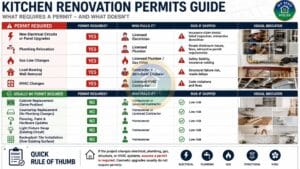
| Work Type | Permit Required? | Who Pulls It? | Risk If Skipped |
|---|---|---|---|
| New electrical circuits or panel upgrades | YES — all jurisdictions | Licensed electrician | Insurance voiding; retroactive demo required |
| Plumbing relocation | YES — all jurisdictions | Licensed plumber | Resale disclosure problem; fine + retroactive permit |
| Gas line changes | YES — all jurisdictions | Licensed plumber/gas fitter | Safety liability + insurance void |
| Load-bearing wall removal | YES — all jurisdictions | Contractor + structural engineer sign-off | Structural safety risk; resale halt |
| HVAC changes | YES — most jurisdictions | Licensed HVAC contractor | Code violation; fine at resale |
| Cabinet replacement (same position) | NO — most jurisdictions | N/A | N/A |
| Countertop swap (no plumbing change) | NO — most jurisdictions | N/A | N/A |
| Flooring, paint, hardware | NO — all jurisdictions | N/A | N/A |
| Light fixture swap (existing circuit) | NO — most jurisdictions | N/A | N/A |
| Backsplash tile (over existing) | NO — most jurisdictions | N/A | N/A |
Permit trigger list confirmed across Angi Kitchen Remodel Permit guide 2026, HomeGuide building department data 2026, and Wood Contracting Chicago city-specific data 2026. “Most jurisdictions” means the permit requirement is near-universal but local codes can vary — always verify with your building department.
The permit cost range for kitchen work nationally runs $200–$2,000 depending on jurisdiction and scope, per Angi 2026 and PermitCalculator.com’s verified municipal data. Two illustrative examples anchor the range. Austin, TX: a $25,000 kitchen remodel generates approximately $604 in total permit fees ($370 building + $167 electrical + $67 plumbing base, per Austin Development Services fee schedule). Chicago, IL: the same project scope can generate $1,800–$4,200 in kitchen permits alone, plus separate electrical ($200–$600), plumbing ($300–$800), and HVAC ($250–$700) permits, with a processing timeline of 7–9 weeks (Wood Contracting Chicago, 2026).
Permit timelines matter for project scheduling. Basic permits are sometimes issued same-day. Structural building permits typically take 4–6 weeks to process nationally (Angi 2026). A final inspection is required before project close-out in all jurisdictions. A failed inspection means corrective work plus a follow-up inspection visit, adding both cost and time to the project close.
The consequences of skipping permits are not theoretical. Per HomeGuide’s 2026 building department data, unpermitted work can trigger fines and project shutdown; a requirement to demolish non-compliant work; retroactive permit costs that can double or triple the original fee; resale disclosure problems that buyers’ inspectors and title companies routinely flag; and voiding of homeowner’s insurance on claims related to the unpermitted scope. A $200 plumbing permit can expose existing wiring to inspection, and inspectors can require code upgrades to adjacent systems that trigger $2,000–$4,000 in unplanned electrical work (Cost to Renovate, April 2026). The permit is not the cost. The permit is the insurance against a larger one.
FAQ: Questions Every Small Kitchen Remodel Owner Asks Before Committing

What is the average cost to remodel a small kitchen in 2026?
For kitchens under 100 square feet, the realistic cost range is $9,000–$30,000 depending on scope. A limited cosmetic refresh (hardware, paint, backsplash) can land at the low end. A full renovation including cabinet refacing, quartz countertops, new appliances, and LVP flooring typically runs $18,000–$28,000. The national average across all kitchen sizes is $26,962, with a typical project range of $14,585–$41,534, per Angi’s 2026 cost data. Your final number hinges on three variables: whether you move plumbing or electrical, which cabinet tier you choose, and your local labor market.
What kitchen upgrades give the best return on investment in 2026?
Targeted cosmetic upgrades deliver the strongest ROI, not full gut renovations. According to the 2025 Cost vs. Value Report published by Zonda, a minor midrange kitchen remodel (cabinet refacing, new countertops, updated appliances, new sink, resilient flooring) returns 113% of its cost nationally. It is the only interior home improvement project in the national top five for ROI; the four projects ranking above it are all exterior. Individually, cabinet painting and hardware swaps together deliver approximately 90% ROI per Remodeling Magazine 2026 data. Diminishing returns begin above $40,000–$50,000 in spending.
What kitchen remodeling work can I do without a permit?
The following upgrades are confirmed no-permit in most US jurisdictions, per Angi’s 2026 Kitchen Remodel Permit guide:
- Cabinet painting and hardware swaps
- Backsplash tile installation over existing tile
- LVP floating floor installation (click-lock, no adhesive)
- Light fixture replacement on an existing circuit
- Under-sink pull-out organizers
- Open shelving (stud-anchored installation)
- Countertop swaps that don’t involve moving plumbing
Always verify with your local building department before starting. Permit requirements are stricter in HOA communities, condominiums, and homes built before 1978, where EPA lead-safe renovation rules apply independently of standard permit requirements.
Should I keep or change my small kitchen layout?
Keep your layout unless the current configuration makes the space fundamentally unusable. Keeping existing plumbing and electrical in place saves 20–40% of your total remodel cost, according to NAHB remodeling survey data and 2026 binding-bid data across 40+ US metros. Moving a kitchen sink alone costs $1,000–$3,500 for a standard relocation; load-bearing wall removal adds $3,000–$10,000+. On a $25,000 small kitchen remodel, a single sink relocation consumes 8–14% of the entire budget before a cabinet or countertop is selected. Cosmetic upgrades within the existing footprint consistently outperform structural changes on ROI.
What is the best countertop material for a small kitchen?
Quartz at $60–$110 per square foot installed is the strongest all-around choice. It requires zero maintenance, is non-porous, and is recognized by buyers at resale. 78% of NKBA design professionals expect quartz to remain the top countertop choice for at least three more years. In a small kitchen with roughly 35 square feet of counter surface, the total installed cost at the national average of $88/sq ft is approximately $3,080, making premium material achievable at small-kitchen scale. Granite ($80–$150/sq ft) is a strong alternative for resale-driven buyers. Butcher block ($50–$100/sq ft) works best as a contrast island or peninsula surface rather than the primary countertop.
How long does a small kitchen remodel take?
Timeline depends entirely on scope:
- Cosmetic refresh only (painting, hardware, backsplash, flooring): 1–2 weeks
- Cosmetic remodel including countertop swap: 3–5 weeks; countertop fabrication requires 1–2 weeks after templating
- Full remodel with cabinet refacing: 4–6 weeks including installation and countertop lead time
- Full remodel with new cabinet replacement: 6–10 weeks for stock or semi-custom; 12–18+ weeks for custom cabinets (10–16 week lead time alone)
- Any scope requiring permits: add 2–6 weeks for permit processing before work can legally begin
Plan for the upper end of each range. Material delays, inspection scheduling, and contractor availability routinely extend timelines by 1–2 weeks even on well-managed projects.
What is the difference between cabinet refacing and cabinet replacement and which is better for a small kitchen?
Cabinet refacing keeps your existing cabinet boxes and replaces only the doors, drawer fronts, and hardware. It costs $4,000–$9,000 for a small kitchen and takes 1–2 weeks. Full replacement costs $8,000–$15,000+ and takes 4–8 weeks including lead time. For small kitchens with structurally sound boxes, refacing is almost always the better financial decision. It delivers 70–96% ROI per Remodeling Magazine and NAR data, costs 78% less than full replacement, and produces the same visual result that buyers notice at resale. Replace only if your existing cabinet boxes are warped, water-damaged, or structurally compromised.
What small kitchen remodel ideas add the most value before selling a home?
Focus on the five upgrades that buyers consistently notice and that produce the highest return per dollar spent: cabinet refacing or painting, a countertop swap from laminate to quartz, a new backsplash, updated hardware and faucet, and improved lighting. These five upgrades combined typically run $8,000–$18,000 for a small kitchen and represent the core of the minor midrange remodel scope that Zonda’s 2025 Cost vs. Value Report documents at 113% ROI nationally. Avoid structural changes, custom cabinetry, or luxury appliances if your primary motivation is resale. ROI drops sharply above $40,000–$50,000 in total spending.
Is a small kitchen remodel worth it if I’m not planning to sell?
Yes. Kitchen remodels deliver both financial and personal ROI. The NAR/NARI 2025 Remodeling Impact Report found that 64% of homeowners report a greater desire to be at home after completing a renovation, a result driven significantly by kitchen projects. Kitchen upgrades earned a perfect Joy Score of 10 out of 10 in that same report, one of the highest satisfaction scores of any project type, tied with primary bedroom suite additions and new roofing. For long-term owners, the daily usability gain from better storage, lighting, and surfaces compounds across years of use. The financial return is still there at resale; it simply isn’t the only measure of value.
How much does it cost to remodel a small kitchen on a tight budget?
A functional cosmetic refresh of a small kitchen under 100 square feet can be completed for $3,000–$8,000 by focusing on no-permit, DIY-eligible upgrades: cabinet painting ($200–$500 in materials), new hardware ($150–$400), a tile backsplash ($200–$500 DIY), LVP floating flooring ($320–$1,280 for under 80 sq ft), and under-cabinet LED lighting ($50–$200 plug-in). This scope requires no contractor, no permits, and no structural changes. It produces a meaningful visual transformation and is the entry-level scope that makes a kitchen competitive at resale without the investment of a full professional remodel.
What is the best kitchen layout for a small space?
The galley layout is the most cost-efficient and ergonomically effective configuration for most small kitchens. It keeps all work surfaces within a tight corridor (42–48 inches wide per NKBA guidelines), minimizes plumbing runs, and costs $16,200–$31,600 nationally for a complete remodel. For kitchens under 60–80 square feet, the single-wall (I-shaped) layout is even more affordable at $10,000–$25,000. It eliminates corner hardware and second-wall labor entirely. The L-shaped layout is the most popular nationally and works well in open-concept homes where sightlines to the living area matter. Peninsula layouts add seating and counter space for $1,500–$5,000 added to an existing base layout.
How do I maximize storage in a small kitchen without remodeling?
Seven no-permit, low-cost storage upgrades that work in any small kitchen.
- under-sink pull-out organizers ($27–$54 at Home Depot, no tools required).
- magnetic knife strips ($15–$75, wall-mounted).
- wall-mounted spice racks ($14–$50 per unit).
- pegboard systems ($30–$150 for a full kitchen kit).
- over-door organizers for pantry doors ($20–$60).
- toe-kick drawers if your cabinets have accessible kickplate space ($150–$400 per drawer with a carpenter).
- ceiling-height cabinet extensions above existing uppers ($800–$2,500). Items 1–4 require no tools, no permanent wall changes, and are fully renter-eligible.
What kitchen remodel mistakes cost the most money?
The five highest-cost small kitchen remodel mistakes, ranked by financial impact:
- Moving plumbing, which adds $1,000–$3,500+ per trade line before a single cabinet ships.
- Choosing full custom cabinets for a standard-dimension kitchen, where $500–$1,200+/linear ft adds cost without proportional resale return.
- Skipping permits on structural or electrical work, where retroactive permit costs, required demolition, and resale disclosure problems can cost far more than the original permit fee.
- Selecting countertop material before locking in cabinet tier, which can create material incompatibilities requiring refabrication.
- Over-improving for the neighborhood, where spending $60,000+ on a kitchen in a $300,000 market produces a 36% ROI ceiling regardless of finish quality.
Conclusion: Scope Control Is the Lever
The data across this guide points in one consistent direction. Scope control is what separates a 113% return from a 36% one. A small kitchen remodel is not a consolation prize for homeowners who can’t afford more space. It is the highest-ROI interior investment available in 2026, precisely because a targeted cosmetic update appeals to the widest buyer pool at the lowest cost.
The order of decisions matters. Lock in your layout before selecting materials. Choose your cabinet tier before choosing your countertop. Exhaust no-permit upgrades before authorizing any structural work. And don’t move plumbing unless the current position makes the kitchen functionally unusable.
For most small kitchen owners, the path to maximum return runs through ideas 1–3 on the ranked list: cabinet refacing, a laminate-to-quartz countertop swap, and a lighting upgrade. Those three changes, executed within the existing footprint and without a permit, produce the visual and financial result that drives the Zonda data. Everything after that is a finishing layer, valuable but not load-bearing to the return.
Before finalizing your scope, run your exact project through the Kitchen Renovation Cost Calculator to see where your spending sits on the ROI curve. The gap between a minor remodel that returns $32,141 and a major gut renovation that returns 36 cents on the dollar is not a question of quality. It is a question of scope. The calculator tells you which side of that line you are on before you commit to anything.
Sources & Research References
The cost figures, ROI percentages, and industry trend data cited throughout this guide are drawn from primary research reports, government labor statistics, and verified contractor cost databases. All figures reflect national US averages as of 2026. Regional labor markets, material availability, and local permit fee schedules vary. Consult a licensed contractor in your market for a project-specific estimate before committing to any scope.
Primary Industry Research
These are the Tier 1 sources this guide relies on for market data, consumer behavior statistics, and ROI benchmarks. All are published by recognized industry research bodies, trade associations, or government-adjacent data providers.
Zonda / Journal of Light Construction — 2025 Cost vs. Value Report
The authoritative annual report measuring average project cost versus resale value for 22 remodeling projects across 150 US markets. Source for the 112.9% minor kitchen remodel ROI figure, the $28,458 average job cost, and the $32,141 resale value cited in this guide.
View the 2025 Cost vs. Value Report
NKBA — 2026 Kitchen & Bath Industry Trends Report
Annual survey of 634 kitchen and bath industry professionals covering material preferences, design direction, storage trends, lighting priorities, and countertop forecasts. Source for wood grain surpassing painted cabinets, white oak at 51%, flat/slab door styles at 69%, slab backsplash adoption at 75%, and enhanced storage gaining traction at 72%.
View the NKBA 2026 Trends Report
Houzz — 2026 U.S. Kitchen Trends Study
Annual consumer survey of 1,780 US homeowners who renovated or are planning to renovate their kitchen, surveyed July 6–30, 2025. Source for upgrade frequency data (countertops 91%, backsplash 85%, cabinets 84%), wood overtaking white in cabinet color adoption (29% vs. 28%), butcher block island surge (+13 points YoY), specialty storage at 94%, and the $46,000 median spend for smaller kitchen major remodels.
View the 2026 Houzz Kitchen Trends Study
Houzz — 2026 Renovation Plans Report
Companion report to the Kitchen Trends Study covering homeowner budget intentions, renovation confidence, and professional hiring rates across all renovation categories. Source for the 75% of homeowners expecting to spend at least $10,000, trade specialist hiring rates on $50,000+ projects (electricians 52%, cabinet specialists 39%, plumbers 35%), and 87% professional involvement rate.
NAR / NARI — 2025 Remodeling Impact Report
Published April 9, 2025, by the National Association of Realtors and the National Association of the Remodeling Industry. Covers homeowner satisfaction (Joy Scores), Realtor-reported demand data, and project cost recovery across 20 remodeling project types. Source for the kitchen upgrade Joy Score of 10 out of 10, the 64% of homeowners reporting a greater desire to be at home after renovation, and the 48% of Realtors citing increased kitchen upgrade demand.
View the NAR 2025 Remodeling Impact Report
Cost Data Sources
No Tier 1 source (NKBA, Houzz, or Zonda) publishes installed per-unit cost data in their public reports. All cost ranges in this guide are drawn from the following verified contractor cost databases and cost aggregators. Each source is labeled in the article where cited.
Angi (2026)
Contractor cost aggregator drawing on verified project cost data from licensed professionals across all 50 US states. Sources for cabinet refacing ($4,484–$10,586), backsplash installation ($480–$1,500), cabinet painting ($425–$1,465), kitchen faucet installation ($262 average), galley kitchen remodel ($16,200–$31,600), quartz countertop cost ($50–$200/sq ft), porcelain slab ($65–$120/sq ft), butcher block ($50–$150/sq ft), and permit cost ranges.
Angi Small Kitchen Remodel Cost Guide
Angi Kitchen Remodel Permit Guide
HomeGuide (2026)
Contractor cost aggregator. Sources for granite countertop installed cost ($80–$150/sq ft), LVP flooring installation cost, cabinet installation cost by tier, pantry cabinet cost, and IKEA ceiling-height cabinet pricing ($600–$1,200 per unit).
Homewyse — May 2026 (BLS-Derived)
Cost calculator using Bureau of Labor Statistics occupational wage data to produce per-unit installed cost estimates. Sources for quartz countertop installation ($120–$157/sq ft), granite installation ($96.58–$141/sq ft), butcher block installation ($67.08–$94.27/sq ft), backsplash tile installation ($32.95–$56.21/sq ft), and plumbing relocation ($935–$1,138 per piping run).
Homewyse Cost Calculator
PermitCalculator.com — 2026
Permit cost database built by David Olson from verified municipal fee schedules across 29 US cities in 19 states. Source for the national average kitchen remodel permit fee ($647), median permit fee ($471), and city-by-city permit cost breakdown (Kansas City, MO at $158 to Seattle, WA at $2,130).
View Kitchen Remodel Permit Cost Data
SlabWise Fabricator Survey — March 2026
National survey of countertop fabricators reporting installed pricing by material. Source for the butcher block national average of $58 per square foot installed for standard hardwoods.
Fixr — 2025 Cost vs. Value Analysis
Independent synthesis of Zonda Cost vs. Value data. Source for corroboration of the 112.9% minor kitchen remodel ROI figure and documentation of the year-over-year increase from 96.1% (2024) to 113% (2025).
View Fixr Cost vs. Value Analysis
HomeLight (January 2026), SimplyWise (June 2026), Highland Cabinetry (2026), KitchenSearch (April 2026)
Multiple contractor cost databases used for cross-verification of cabinet tier pricing: stock ($100–$300/linear ft installed), semi-custom ($150–$650/linear ft installed), and full custom ($500–$1,200+/linear ft installed). No single source is used in isolation for cabinet tier cost ranges; all four are cited together to reflect the national range.
Storage Hardware Pricing
Home Depot — 2026 Verified Product Listings
Source for Rev-A-Shelf 2-tier blind corner pull-out organizer ($532.99 retail, verified product listing) and under-sink pull-out organizer 2-pack ($53.67 retail, verified product listing).
Houzz Editorial — EW Kitchens VP Dennis Palazzolo
Industry professional quote source for toe-kick drawer pricing: $175–$225 per drawer when ordered with new cabinets; approximately $150 per drawer for carpenter retrofit into existing cabinetry.
View Houzz Toe-Kick Drawer Guide
Bob Vila / Fixr — Pull-Out Shelf Installation Data
Source for pull-out shelf installation average of $245 per shelf (range: $140–$350), citing Fixr national cost data.
Lowe’s — 2026 Product Listings
Source for Lynk Professional under-sink pull-out organizer pricing ($30–$80 per unit, self-install).
KitchenBrief (April 2026)
Source for magnetic knife strip retail pricing ($15–$75).
Homes & Gardens (February 2026)
Source for IKEA SKADIS pegboard system recommendation for small kitchen storage; kit pricing $30–$150 with accessories.
Permit and Legal References
Angi Kitchen Remodel Permit Guide — 2026
Source for the universal permit trigger list (what always requires a permit across all US jurisdictions), the no-permit upgrade list, and permit processing timeline data (basic permits: same-day; structural: 4–6 weeks nationally).
View Angi Permit Guide
HomeGuide Building Permit Cost Guide — 2026
Source for permit cost range ($500–$1,500 based on project value) and consequences of skipping permits (fines, project shutdown, demolition requirement, resale disclosure complications, insurance voiding).
Wood Contracting Chicago — 2026
Licensed Chicago-area contractor. Source for Chicago-specific permit cost breakdown used as an illustrative high-cost metro example: kitchen remodeling permits $1,800–$4,200; electrical $200–$600; plumbing $300–$800; mechanical/HVAC $250–$700; processing timeline 7–9 weeks.
PermitCalculator.com — Austin, TX City Page (March 2026)
Verified from Austin Development Services published fee schedule. Source for Austin flat-fee permit structure used as illustrative low-to-mid cost metro example: building permit $370 flat for projects $8,000–$50,000; electrical $167 base; plumbing $67 base; total approximately $604 for a $25,000 remodel.
View Austin Permit Data
Cost to Renovate — Renovation Permit Guide (April 2026)
Source for the illustration that a $200 plumbing permit can expose adjacent systems to inspection, potentially triggering $2,000–$4,000 in unplanned electrical upgrades.
ROI References
Remodeling Magazine / CabinetSelect.com — 2026 Cost vs. Value Data
Source for individual upgrade ROI figures: cabinet refacing 70–96%, cabinet painting 70–80%, lighting updates 70–85%, hardware and paint together 90%. CabinetSelect.com synthesizes Remodeling Magazine Cost vs. Value data for individual upgrade categories.
Opendoor — Citing Zonda Cost vs. Value 2025
Source for standalone countertop replacement returning 60–80 cents on the dollar at resale.
Modernize — 2026
Source for cabinet refacing costing 78% less than full cabinet replacement on average.
Costtorenovate.com — 2026
Source for hardware and cabinet paint together achieving 90% ROI as a combined upgrade pairing.
This guide was researched, written, and editorially reviewed by the MyRenoHouse editorial team. Cost data is updated annually. For the most current figures in your specific market, consult a licensed general contractor or use the Kitchen Renovation Cost Calculator to stress-test your project scope before signing any contractor agreement.