


The average bathroom remodel cost in 2026 lands around $15,000 for a primary bathroom, with most U.S. homeowners spending somewhere between $8,000 and $45,000. The final figure depends on the size of the room, the materials you pick, and whether the plumbing gets moved. That is the number most people come here for, but it hides a lot of variation. Two bathrooms of exactly the same size can finish $20,000 apart, and the difference almost never comes down to square footage. It comes down to the decisions you make inside that footprint.
That gap is exactly why 2026 pricing deserves a fresh look. A persistent skilled-labor shortage, higher material costs, and updated building codes have all pushed budgets up from where they sat even two years ago, so cost data from an older guide can lead you badly astray. This guide breaks the numbers down the way a contractor actually estimates a job: by scope, by size, by fixture, and by region. It then layers in ROI, the code requirements that quietly inflate budgets, and practical ways to bring the total down without cutting corners you will regret. If a bathroom is part of a larger project, many of the same budgeting principles carry over from our 2026 kitchen remodel guide for U.S. homeowners.
Let’s start with the fast answer.
How Much Does a Bathroom Remodel Cost in 2026? (Quick Answer)

For a typical mid-range project in the United States, expect to pay $180 to $280 per square foot, or roughly $16,000 to $28,000 for a complete renovation. Budget refreshes start far lower, and luxury spa builds climb far higher. Here is the whole picture at a glance.
| Metric | 2026 Figure |
|---|---|
| Median primary-bath spend | ~$15,000 |
| Typical budget band | $8,000 to $45,000 |
| Full possible range | $6,456 (cosmetic) to $81,612+ (luxury suite) |
| Mid-range benchmark | $26,138 |
| Cost per square foot, budget | $80 to $120 |
| Cost per square foot, mid-range | $180 to $280 |
| Cost per square foot, luxury | $500 to $800+ |
| Year-over-year change | +4% to +6% vs. 2025 |
✅ Key Takeaway: The single biggest cost lever is not the size of your bathroom. It is whether you keep the plumbing where it is. Moving fixtures, choosing a custom tiled shower, and upgrading to natural stone are what separate a $12,000 project from a $30,000 one.
Two numbers in this guide can look like they disagree, so here is the distinction: the roughly $15,000 median is what a typical homeowner spends across all project types, including cosmetic refreshes and partial updates, while the $26,138 figure is the benchmark for a complete mid-range renovation. Smaller, partial projects pull the median below the cost of a full remodel.
These are national averages. Where you live can swing the final bill by 40% or more in either direction, which we cover in the regional section below.
Bathroom Remodel Cost by Project Scope (Budget to Luxury)
The quickest way to a number that actually applies to you is to identify your project tier. Contractors think in terms of scope, meaning how much of the room you are changing, because that dictates how many trades are involved and how long they are on site.
| Remodel Tier | 2026 Cost Range | Typical Scope of Work |
|---|---|---|
| Budget Refresh | $5,000 to $10,000 | Fresh paint, new fixtures and hardware, updated lighting and mirror; existing layout and plumbing retained |
| Mid-Range Update | $16,000 to $28,000 | Full fixture replacement, new tiled shower surround, upgraded flooring, new vanity and countertop, professional plumbing and electrical labor |
| High-End Remodel | $30,000 to $50,000 | Custom cabinetry, natural stone surfaces, minor structural changes, frameless glass shower enclosures |
| Luxury Custom | $60,000 to $120,000+ | Full layout reconfiguration, curbless wet room, radiant floor heating, smart technology, premium fixtures |
The dividing line that matters most runs between the Budget Refresh and everything above it. The question is simple: do you keep the existing layout, or change it? A refresh works within the walls and plumbing you already have, which is why it stays affordable. The moment you move a toilet, relocate a shower, or open a wall, you cross into mid-range territory and the trades multiply.
Most homeowners land in the Mid-Range Update tier, and for good reason. It delivers the best balance of visible transformation and controlled cost, and it is the tier that returns the most at resale. The national mid-range benchmark sits at $26,138, a figure worth anchoring your expectations to if you are planning a full, professional renovation rather than a cosmetic facelift.
Bathroom Remodel Cost by Size & Room Type
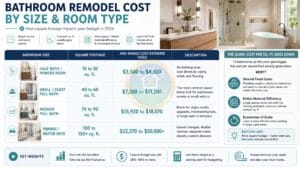
The footprint of the room is your baseline: more square footage means more tile, more flooring, and larger cabinetry. But there is a quirk unique to bathrooms that trips up a lot of budgeters. As the room gets bigger, the cost per square foot usually goes down. We will explain why in a moment, but first, here is what different sizes typically cost.
| Bathroom Size | Square Footage | Mid-Range Cost Estimate | Description |
|---|---|---|---|
| Half Bath / Powder Room | 15 to 30 sq. ft. | $3,500 to $8,500 | No bathing area; cost driven by vanity, toilet, and flooring |
| Small / Guest Full Bath | 40 to 60 sq. ft. | $7,200 to $11,200 | The most common layout (often 5×8 ft); tub/shower combo or small walk-in |
| Medium Full Bath | 70 to 90 sq. ft. | $15,920 to $18,070 | Room for single-vanity upgrades, freestanding tubs, or large walk-in showers |
| Primary / Master Suite | 100 to 150+ sq. ft. | $22,370 to $50,000+ | Layout changes, double vanities, separate water closets, custom showers |
How Much Does It Cost to Renovate a Small Bathroom (Including 5×8)?
A small bathroom is the most common project in the country, and the good news is that it is also the most forgiving on a budget. To renovate a small bathroom in the 40-to-60-square-foot range, the classic 5×8 layout, a mid-range remodel typically runs $7,200 to $11,200. Keep it to a cosmetic refresh and you are looking at roughly $3,200 to $4,800. Push into high-end finishes and it climbs to $12,000 to $18,000 or more.
Because the room is small, your material dollars go further per visible surface, which makes a small bathroom the best place to renovate on a budget. A single statement tile, a quality stock vanity, and a coordinated set of matte-black or brushed-brass fixtures can transform the space for a fraction of what the same upgrades cost in a primary suite.
💡 Pro Tip: In a small bathroom, spend on the two things you touch and look at every day, the vanity and the shower, and save everywhere else. The impact per dollar is higher here than in any other room in the house.
Master / Primary Bathroom Renovation Cost
At the other end, a master bathroom remodel cost ranges from about $8,000 for a modest refresh to $30,000+ for a full renovation. A true luxury primary suite, with a freestanding tub, curbless walk-in shower, double vanity, and heated floors, can reach $50,000 to $80,000 or more. Master baths cost the most not because they are large, but because they are fixture-dense: two sinks, a separate tub and shower, and often a layout change all stack up. Scope and complexity, not square footage alone, drive the premium.
Why Small Bathrooms Cost More Per Square Foot
Here is the counterintuitive part. A compact 40-square-foot bathroom might cost around $200 per square foot, while a spacious 120-square-foot bathroom costs closer to $150 per square foot, even though the big one has a higher total price.
The reason is fixed costs. Every bathroom, regardless of size, needs the same expensive core: plumbing rough-in for a toilet, sink, and shower; a waterproofing membrane; dedicated electrical circuits; and ventilation. In a small room, all that fixed cost is compressed into a tiny footprint, so the per-square-foot figure looks high. In a large room, the same fixed costs are spread across more area, and the cheaper filler square footage, such as flooring and wall tile, dilutes the average.
✅ Key Takeaway: Do not judge a small bathroom by its per-square-foot number, because it will always look expensive. Judge it by scope instead. This is also why you cannot simply multiply a big bathroom’s rate by your small room’s size and expect an accurate estimate.
Bathroom Remodel Cost Breakdown by Fixture & Component
When you are evaluating a contractor’s proposal or building your own bathroom remodeling cost estimate, it helps to know what each piece should cost on its own. Here is the line-item breakdown for 2026.
| Component | Standard Range | Premium / Custom Range |
|---|---|---|
| Shower installation | $400 to $8,500 (prefab) | $7,875 to $15,000+ (custom tile) |
| Bathtub | $400 to $1,500 (standard) | $5,000 to $9,400+ (freestanding) |
| Vanity (with sink) | $525 to $1,200 (stock) | $3,000 to $5,000+ (custom) |
| Toilet | $105 to $630 (standard) | $1,500 to $5,000 (smart toilet) |
| Flooring (installed) | $525 to $1,200 (porcelain/vinyl) | $2,500 to $3,700+ (natural stone) |
| Lighting (per fixture) | $32 to $150 (basic) | $400 to $800+ (designer/smart) |
One pattern dominates this table: the wet area eats the budget. The shower and tub zone routinely accounts for up to 70% of a full remodel’s material cost. That is not markup. It is the reality of waterproofing and the highly skilled tile labor a durable, leak-free enclosure demands. In fact, materials as a whole were cited by nearly 74% of homeowners as the single biggest driver of cost overruns, which is why locking in your selections before demolition starts is one of the most effective budget-control moves you can make.
If you are weighing surface materials for the wet zone specifically, it is worth understanding the trade-offs between porcelain and natural stone before you commit, since that one choice can swing your tile line item by thousands.
Tub-to-Shower & Walk-In Shower Conversion Cost
Converting a tub to a walk-in shower is one of the most-requested projects of 2026, and the tub-to-shower conversion cost depends far more on your foundation than on the shower itself.
- Basic prefab conversion (same footprint): $2,000 to $8,000
- Custom tiled walk-in shower: averages about $7,875, frequently $15,000+
- Frameless glass and fully tiled walls: adds significantly on top
The hidden variable is your foundation. On a slab foundation, rerouting the shower drain means cutting and re-patching concrete, which can double or triple the plumbing portion of the job. On a raised foundation with crawl-space access underneath, the same conversion is far cheaper.
🔑 My Reno House Insight: If you are converting your only tub, keep a bathtub somewhere else in the house. Families with young children actively screen for at least one tub when buying, and removing your last one can quietly cost you buyers down the road.
Vanity, Countertop & Cabinetry Costs
A prefabricated vanity is where budget-minded remodelers save the most without visible compromise. Stock units run $525 to $2,940 and often arrive with the countertop and undermount sink already attached, so no separate stone fabricator is required. Step up to custom cabinetry built to exact dimensions and you are looking at $1,000 to $3,500+, and that is before the countertop, which adds another $200 to $4,000 depending on whether you choose laminate, standard quartz, or premium natural stone. For most homeowners, a semi-custom or stock vanity cuts cabinetry cost by more than half with little sacrifice in looks.
How Much Does It Cost to Add a Bathroom? (Bathroom Addition Cost)
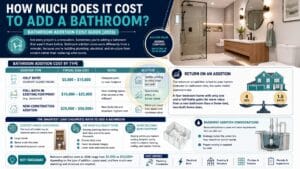
Not every project is a renovation. Sometimes you are adding a bathroom that was not there before. The bathroom addition cost works differently from a remodel, because you are building plumbing, electrical, and structure from scratch rather than replacing what exists.
| Addition Type | Typical 2026 Cost | Notes |
|---|---|---|
| Half bath (convert closet/nook) | $5,000 to $15,000 | Cheapest path; no new footprint |
| Full bath in existing footprint (e.g., basement) | $10,000 to $25,000 | Uses existing space; drain access is the wildcard |
| New-construction addition | $25,000 to $50,000+ | New footprint and structure; highest cost |
The return on an addition is tied to your home’s bedroom-to-bathroom ratio, the same metric appraisers use. A four-bedroom home with only one and a half baths gains far more value from a new bathroom than a three-bed, two-bath home does. The cheapest way to add one is to convert existing under-used space: a large closet, a spot under the stairs, or an unfinished basement corner where you avoid building an entirely new footprint. Just note that basement additions bring their own considerations around drainage below the sewer line, which may require an ejector pump, and code-compliant venting.
2026 Labor Costs & the Skilled-Trade Shortage
Labor is the line item that surprises people most, because it is the largest and the least negotiable. In 2026, labor accounts for 40% to 65% of a total bathroom budget. A bathroom is one of the most densely engineered rooms in any house, with plumbers, electricians, and tile setters all working in a space smaller than a parking spot, and that concentration of skilled trades drives cost up.
The ongoing skilled-labor shortage has pushed rates higher across every trade.
| Trade | 2026 Rate | Year-over-Year Change |
|---|---|---|
| General contractor | $300 to $500 / day | +4% to +6% |
| Licensed plumber | $85 to $175 / hour | +8% to +10% |
| Electrician | $60 to $145 / hour | +6% to +8% |
| Tile setter | $12 to $22 / sq. ft. | Rising with demand |
The general contractor who coordinates these trades, sequences inspections, and keeps the project moving is earning that day rate. Managing overlapping trades in a confined space is genuinely skilled work, and a mismanaged sequence is what turns a five-week job into a three-month one.
Changing your layout is the other major labor threshold. Moving a core plumbing fixture, which means rerouting supply lines, drains, and vent stacks, adds $500 to $1,500 per fixture. Relocating a toilet is the most expensive of all, often adding up to $1,500 on its own because of the precise drain slope and venting it requires.
⚠️ Warning: If a bid comes in dramatically below the others, it is usually not a bargain. It is an incomplete scope, or it is priced on pre-2022 labor rates that no longer exist. The gap will reappear as a change order once the walls are open. Always get the full scope in writing.
Regional Bathroom Remodel Costs Across the U.S.
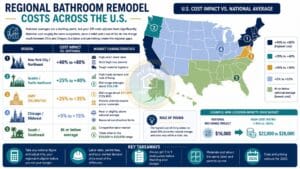
National averages are a starting point, but your ZIP code adjusts them significantly. Materials cost roughly the same everywhere, since a toilet and a box of tile do not change much between Ohio and Oregon, but labor and permitting create the regional gaps.
| Region | Cost Impact vs. National | Market Characteristics |
|---|---|---|
| New York City / Northeast | +40% to +80% | High union labor rates, strict high-rise permits, tough material logistics |
| Seattle / Pacific Northwest | +25% to +40% | High trade demand and cost of living; mid-range averages about $26,138 |
| DMV (DC/MD/VA) | +25% to +35% | Mid-range about $24,000 (72% ROI); historic districts require pricier materials |
| Chicago / Midwest | +5% to +15% | Near or slightly above national average; seasonal construction limits |
| South / Southeast | At or below average | Competitive labor pulls totals toward the $10,000 to $15,000 range |
As a rule of thumb, the highest cost-of-living states run about 20% above the national average, and costs vary within a state, too. A remodel in the D.C. suburbs of northern Virginia will cost far more than the same project in the rural part of the state.
✅ Key Takeaway: Take any national figure in this guide and adjust it by your regional multiplier before you set your budget. A $16,000 mid-range project on paper is closer to $22,000 to $28,000 in a high-cost metro.
Building Codes, Permits & Hidden Costs
This is the section most cost guides skip, and it is where budgets quietly break. Before you finalize a number, you need to account for two things: the hidden conditions demolition tends to uncover, and the code requirements that dictate what you are legally allowed to build.
Start with a contingency fund of 15% to 20% of your total budget. This is not pessimism. It is planning. Roughly 25% of homeowners hit unexpected structural or water repairs once the walls come open: rot behind an old shower surround, corroded cast-iron drain lines, or wiring that does not meet current code. Water-damage remediation alone can add thousands, and the contingency is what keeps your project from stalling in week three.
When you need a permit: any systemic change, such as moving plumbing supply or drain lines, adding electrical circuits, altering load-bearing structure, or modifying ventilation, requires one. Purely cosmetic work like painting or a like-for-like vanity swap generally does not. Skipping a required permit is a false economy. Municipalities can order work torn out for inspection, unpermitted work can void your homeowner’s insurance, and it routinely derails home sales when buyers request documentation.
Two regulatory frameworks shape 2026 budgets across the country.
International Residential Code (IRC), the national baseline. Published by the International Code Council, the IRC is adopted, with local amendments, by most U.S. jurisdictions. Key mandates include:
- GFCI protection on all bathroom receptacles, with at least one outlet within 36 inches of the lavatory basin.
- Spatial clearances: a minimum 21 inches of clear space in front of a toilet, a 30 by 30 inch minimum shower interior, and, for at least one bathroom in a new home, a door width that meets accessibility guidance (about 32 inches).
- Ventilation: an exhaust fan rated at a minimum 50 CFM (intermittent) or 20 CFM (continuous), ducted directly outdoors, never into an attic or soffit.
California Title 24, the marquee state example. Effective January 1, 2026, the updated Title 24 energy standards from the California Energy Commission enforce strict efficiency rules: WaterSense-certified fixtures with toilets capped at 1.28 gallons per flush, faucets at 1.2 GPM, and showerheads at 1.8 GPM, plus high-efficacy LED lighting and vacancy sensors. Complying with Title 24 can add 5% to 10% to a California project, but it also cuts long-term utility costs.
⚠️ Warning: Ducting a bathroom exhaust fan into the attic instead of outside is one of the most common, and most damaging, code violations. It does not remove the moisture. It just relocates the condensation to your roof sheathing, where the repair is far more expensive than a bathroom fix.
Once you understand the costs and the code requirements, the next question is how the work actually gets done, from demolition through final inspection. Our companion walkthrough on how to remodel a bathroom step by step covers the full build sequence, the exact clearances inspectors check, and where hiring a pro pays for itself.
2026 Bathroom Design Trends That Affect Your Budget

Design choices are not just aesthetic. Several of 2026’s most popular features carry a real labor premium, so it pays to understand which trends move your budget. The data below comes from the NKBA 2026 Bath Trends Report, which surveys hundreds of design and build professionals each year.
- The spa-like walk-in shower dominates. About 78% of professionals expect a walk-in shower, separate from the tub, to be the preferred style in the primary suite, and 74% favor frameless glass, often paired with bench seating, rainfall heads, and steam. Curbless, zero-threshold entries are especially requested, but a curbless pan requires a precisely sloped, perfectly waterproofed base, which is skilled and pricier labor.
- Warm, organic palettes replace cool gray. About 64% of designers expect sage green to stay dominant, paired with olive, taupe, and terracotta over light-neutral bases. Warm, wood-faced vanities have overtaken painted cabinetry.
- Large-format tile and minimal grout. Roughly 89% of professionals report that homeowners want minimal or hidden grout lines, driving demand for large-format porcelain (24 by 48 inches and up). These tiles look seamless and cut cleaning, but they demand a perfectly leveled substrate and specialized setting labor.
- Aging-in-place goes mainstream. Of professionals surveyed, 32% call universal design already mainstream and another 48% say it is on its way, built in through curbless entries, comfort-height toilets, and integrated grab bars that no longer look clinical.
- Smart, sustainable features remain a growing priority. Homeowners increasingly choose water-efficient toilets, low-flow shower systems, LED lighting, and smart shower controls that improve comfort while reducing energy and water consumption. These upgrades generally add only a modest premium compared with structural layout changes, making them one of the more cost-effective ways to modernize a bathroom.
💡 Pro Tip: A neutral, nature-accented, matte-finish palette is not just on-trend. It is the safest resale choice. Bold, hyper-specific selections date quickly; this direction does not.
Is a Bathroom Remodel Worth It? ROI & the Cost vs. Value Report
For the resale-minded, bathrooms are among the most dependable places to put renovation dollars, but the return is far from uniform across tiers. According to the Zonda Cost vs. Value Report, the industry benchmark for these figures:
| Project Type | Average Cost | ROI at Resale | Value Added |
|---|---|---|---|
| Mid-range remodel | $26,138 | ~80% | ~$20,915 |
| Universal-design remodel | $42,183 | ~61% | ~$25,700 |
| Upscale / luxury remodel | $81,612 | ~42% | ~$34,000 |
The pattern is clear and worth internalizing: mid-range beats luxury on percentage return. A mid-range remodel recoups about 80% of its cost, one of the best returns of any interior project, while an upscale build recovers only about 42%. That drop happens because highly customized luxury elements appeal to narrow personal tastes rather than broad market demand.
Two rules keep your ROI healthy. First, match your neighborhood. Imported marble in an average-value home will not come back, because appraisers compare you to similar nearby homes. Second, cap total spend at roughly 5% to 15% of your home’s value. Beyond that, you are building for yourself, not for resale, which is fine as long as you know that going in. It is also smart to weigh a bathroom against other high-return projects; comparing it to a kitchen budget using our kitchen remodel guide for U.S. homeowners helps you prioritize where your renovation dollars work hardest.
How to Estimate & Budget Your Bathroom Remodel Cost
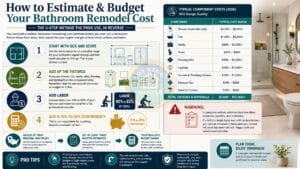
You can build a realistic bathroom remodeling cost estimate before you ever call a contractor. Here is the four-step method the pros use, in reverse:
- Start with size and scope. Use the tables above to set a baseline range for your bathroom’s square footage and how much you plan to change. This is your anchor number.
- Add up the fixtures. Price your shower, tub, vanity, toilet, flooring, and lighting from the component table. Remember that the wet area will dominate, so budget for it first.
- Add labor. Assume labor runs 40% to 65% of your fixtures-and-materials total for a full, professional remodel.
- Add a 15% to 20% contingency. This is non-negotiable for anything beyond a cosmetic refresh.
Then adjust the whole figure by your regional multiplier from the section above, and get at least three written estimates from licensed local contractors.
⚠️ Warning: A complete written estimate itemizes labor, materials, permits, and a timeline. If a bid is a single lump sum with no breakdown, you cannot compare it fairly, and you cannot tell what has been left out. Vague bids are where overruns hide.
How to Save Money: Budget Bathroom Remodel Strategies
A beautiful bathroom does not require an unlimited budget. A well-planned budget bathroom remodel can trim 20% to 30% off the total without any visible drop in quality, as long as you protect the parts you cannot see. Here are the highest-impact savings, ranked:
- Keep the plumbing where it is. This is the single biggest lever. Leaving the toilet, shower, and sink in their existing spots saves $1,500 to $6,500 in rough-in and patching, and far more on major relocations.
- Reglaze instead of replace. A professional tub refinish costs $300 to $700 versus $1,500 to $5,000 for a new tub and install, and it buys another 10 to 15 years if the tub is structurally sound.
- Choose a stock or semi-custom vanity over custom millwork to roughly halve your cabinetry cost.
- Use porcelain that mimics stone. Modern porcelain convincingly imitates marble, travertine, and wood at a fraction of the price, and it is fully waterproof with no sealing required.
- DIY the demolition, but leave waterproofing, plumbing, and electrical to licensed pros.
- Book in the off-season. Search and booking demand peaks in July and March and bottoms out in December, so scheduling in late fall or winter can win you better rates and faster crews.
🔑 My Reno House Insight: The one place never to cut is waterproofing and the labor behind it. Saving $3,000 on a cheap tile install now routinely costs $6,000 later when water finds its way to the studs. Cut on finishes, never on the systems hidden behind the walls.
Bath Fitter, Re-Bath & Big-Box Remodels: Are They Cheaper?
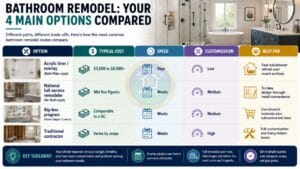
If you have searched bathroom prices, you have run into the national brands. Here is how they actually compare to hiring a traditional contractor.
| Option | Typical Cost | Speed | Customization | Best For |
|---|---|---|---|---|
| Acrylic liner / overlay (Bath Fitter style) | $3,000 to $8,000+ | Days | Low | Fast tub/shower refresh over sound surfaces |
| National full-service remodeler (Re-Bath style) | Mid five figures | Weeks | Medium | Turnkey design-through-install convenience |
| Big-box program (Home Depot / Lowe’s) | Comparable to a GC | Weeks | Medium | Coordinated materials plus subcontracted labor |
| Traditional contractor | Varies by scope | Weeks | High | Full customization and fixing hidden issues |
The trade-off is consistent: liner-and-overlay services win on speed and convenience, while a traditional remodel wins on customization and the ability to fix what is behind the walls.
⚠️ Warning: An acrylic overlay covers the old surface rather than repairing it. If your tile is cracked, grout is failing, or a wall feels soft, an overlay just seals the damage inside. In that situation, a full remodel is not the more expensive option. It is the only one that actually solves the problem.
Frequently Asked Questions
What is the average cost of a bathroom remodel in 2026?
The average bathroom remodel cost in 2026 is about $15,000 for a primary bath, with most projects running between $8,000 and $45,000. A full mid-range renovation benchmarks at $26,138, while cosmetic refreshes can come in under $10,000 and luxury suites exceed $80,000.
How much does it cost to remodel a small bathroom?
A small full bathroom, roughly 40 square feet, typically costs $7,200 to $11,200 for a mid-range remodel, $3,200 to $4,800 for a cosmetic refresh, and $12,000 to $18,000+ for high-end finishes. Small bathrooms are the best candidates for a budget-friendly renovation.
What is the average cost of a 5×8 bathroom remodel?
A standard 5×8 bathroom, 40 square feet, runs $7,200 to $11,200 for a comprehensive mid-range project. It is the most common bathroom size in U.S. homes, usually with a tub/shower combo or a compact walk-in conversion.
How much does a master bathroom remodel cost?
A master or primary bathroom remodel typically costs $8,000 for a modest refresh up to $30,000+ for a full renovation, with luxury spa-style suites reaching $50,000 to $80,000 or more. Fixture density and layout changes, not size alone, drive the cost.
How much does it cost to convert a tub to a shower?
A tub-to-shower conversion costs $2,000 to $8,000 for a basic prefab swap and averages around $7,875, often $15,000+, for a custom tiled walk-in. Costs rise sharply on a slab foundation, where the drain must be cut into and re-patched.
How much does it cost to add a bathroom?
A bathroom addition costs $5,000 to $15,000 for a half bath in existing space, $10,000 to $25,000 for a full bath within the current footprint, and $25,000 to $50,000+ for a new-construction addition. It adds the most value when a home is short on bathrooms relative to bedrooms.
Which part of a bathroom remodel is the most expensive?
Labor is the single most expensive line item, at 40% to 65% of the total. Among materials, the wet area, meaning a custom shower or freestanding tub, consumes the largest share, often up to 70% of the material budget.
How much is a bathroom remodel per square foot?
Expect $80 to $120 per square foot for budget work, $180 to $280 for a mid-range remodel, and $500 to $800+ for luxury. Small bathrooms post higher per-square-foot numbers because fixed plumbing and waterproofing costs do not scale down.
Can you remodel a bathroom for under $10,000?
Yes. A cosmetic refresh or a small-bathroom update fits comfortably under $10,000 if you keep the existing layout, choose a stock vanity, and avoid moving any plumbing. Full mid-range renovations, however, start around $16,000.
Do I need a permit to remodel a bathroom?
Yes, if the project moves plumbing lines, adds electrical circuits, or alters structure. Purely cosmetic work like painting or a like-for-like vanity swap generally does not require one. Always confirm with your local building department before demolition.
What is the ROI of a bathroom remodel?
A mid-range bathroom remodel recoups about 80% of its cost at resale, per the Cost vs. Value Report, one of the highest returns of any interior project. Upscale luxury remodels return around 42%, since custom features appeal to narrower tastes.
How long does a bathroom remodel take?
A cosmetic refresh takes about one to two weeks, a standard full remodel three to five weeks, and a custom gut renovation six to ten weeks or more, plus permit and material lead times. Many of the same scheduling and inspection principles apply as in our kitchen remodel timeline for U.S. homeowners.
Final Thoughts
A bathroom remodel in 2026 is a substantial investment, but it is a knowable one. Budget somewhere in the $8,000 to $45,000 range depending on your scope, remember that the three real cost levers are moving plumbing, your shower choice, and your material grade, and know that labor will claim 40% to 65% of the total no matter what. Hold back a 15% to 20% contingency for the surprises demolition always finds, pull the permits your project requires, and keep your total near 5% to 15% of your home’s value if resale is the goal.
Done right, the payoff is real on both fronts: a bathroom that works as a daily wellness space, and one that returns a strong share of its cost, around 80% for a mid-range project, the moment you list the home. The smartest remodel is not the most expensive one. It is the one that fixes what is dated, funds the waterproofing and plumbing you will never see, and matches the finish level your neighborhood expects.
The best next step is simple. Match this pricing against your own bathroom, set a realistic number with a contingency built in, and get three free, no-obligation estimates from licensed local contractors so you are comparing real bids against the benchmarks above, not guesses. When you are ready to move from budgeting to building, our step-by-step guide to remodeling a bathroom walks through the entire process in the order it actually happens.
Cost figures in this guide are U.S. national averages compiled for 2026 from industry sources including the NKBA 2026 Bath Trends Report, the Zonda Cost vs. Value Report, the International Code Council (IRC), the California Energy Commission (Title 24), and the EPA WaterSense program. Actual costs vary by location, contractor, material quality, and project scope. Always obtain written estimates from licensed local professionals before finalizing your budget.


