


You’ve probably run the math already. Skilled labor eats up a large slice of a bathroom budget, commonly 30 to 50 percent, and cutting it looks like the fastest way to keep a five-figure project from creeping higher. That single number is what pulls most homeowners toward doing it themselves. But that slice isn’t really a fee for hours worked. It’s the price of transferring risk off your shoulders: code compliance, liability, insurance exposure, and the quiet, delayed failures that don’t show up until year two. The moment you pick up the tools, all of that moves onto you.
This guide treats the choice between DIY and hiring a contractor for your bathroom remodel as what it actually is, a risk-allocation decision rather than a price comparison. You’ll get an honest accounting of what DIY genuinely saves (and what it doesn’t), the specific legal and code exposures most people never see coming, and a repeatable method for vetting a professional if you decide to hire one. Named codes, named agencies, real penalty figures, and no generic “get three bids” filler.
Some of it you can absolutely do yourself. The rest of this article is about knowing exactly where that line falls.
The Real Question Isn’t Price. It’s Risk.
Frame the decision correctly and everything else gets easier. You are not choosing between “expensive” and “cheap.” You’re choosing who absorbs the consequences when something behind the wall goes wrong. A full bathroom remodel is a five-figure project, and the money is truly won or lost in the parts nobody sees: the waterproofing membrane, the drain slope, the electrical circuits, the framing that holds a grab bar. Get the visible finishes wrong and you’re annoyed. Get the concealed assemblies wrong and you’re looking at rotted subfloor, a denied insurance claim, or a teardown.
That’s the lens for the whole decision. Cosmetic work carries cosmetic risk. Systems work carries structural, legal, and financial risk, and that risk doesn’t disappear when you skip the contractor. It just changes owners. This page is about the decision, not the price tag. For what a remodel actually costs by tier, labor versus materials, and where the money goes, see our full breakdown of how much a bathroom remodel costs in 2026.
What DIY Actually Saves (and What It Doesn’t)
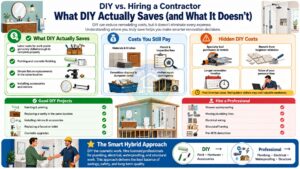
Here’s the part contractor-friendly articles usually skip, and skipping it is exactly why they read like advertising. DIY can save you real money, just not as much, or as cleanly, as the labor line suggests.
What you genuinely save is the labor cost, and only on work you’re actually competent to perform to a finished, lasting standard.
What DIY does not eliminate:
- Materials and finishes (the largest bucket, and it doesn’t shrink because you’re swinging the hammer)
- Permit and inspection fees
- Demolition disposal and dumpster rental
- A contingency reserve for whatever the walls are hiding
What DIY quietly adds:
- Specialty tools you buy or rent for one job (wet saw, tile leveling systems, oscillating multi-tool)
- Rework, the near-certain cost of first-attempt mistakes redone with new material
- A longer schedule with the bathroom out of service, which matters more in a one-bathroom home (how long a remodel actually takes is its own planning problem)
- The opportunity cost of your own hours, a real, quantifiable number if your time has professional value
That last point is the one high-earning homeowners underweight. Forty weekend hours spent learning to set tile is forty hours not spent on anything else, and the first attempt rarely looks like the tenth.
Where DIY Is Genuinely Sound, and Where It Isn’t
The honest answer isn’t “all or nothing.” It’s a line drawn by trade and risk.
| Reasonable to DIY | Hire a licensed professional |
| Painting and priming | Shower waterproofing and pan construction |
| Swapping a vanity in the same location | Relocating drain or supply lines |
| Installing mirrors, accessories, hardware | New or altered electrical circuits |
| Replacing a faucet or toilet in place | Structural framing changes |
| Non-structural cosmetic updates | Any demolition in a pre-1978 home |
This is why the hybrid model is the pragmatic answer for so many people. Do the finish layer yourself (paint, hardware, accessories, in-place fixture swaps) and hire licensed trades for the wet-wall and systems work where a mistake is expensive, dangerous, or both.
What the Labor Premium Actually Buys
When you hire a competent contractor, the price above raw materials isn’t markup for its own sake. It’s a bundle of protections that transfer off you the instant the contract is signed:
- Insurance: general liability and workers’ compensation covering injury and damage on your property
- Warranty: a responsible party to call when something fails
- Code liability: the professional, not you, answers to the inspector
- Schedule accountability: a contracted completion target, not an open-ended weekend project
- Subcontractor management: one point of coordination across plumber, electrician, and tile setter
Eliminating the labor cost doesn’t eliminate the work. It relocates the liability. You still have to build the shower correctly; you’ve just removed the insured, licensed, warranty-backed party who would otherwise have carried the consequences of building it wrong.
Labor commonly runs 30 to 50 percent of a bathroom remodel, but the full breakdown, and how that ratio shifts with plumbing relocation, custom tile, and geography, lives in our bathroom remodel cost guide. What matters for this decision is understanding what that premium is protecting you from. The next three sections spell out exactly that.
The Hidden Legal and Financial Risks of Going It Alone

This is the exposure most homeowners never see until the worst possible moment, a claim or a sale.
Permits aren’t bureaucratic friction. They’re the mechanism by which your property stays insurable. Insurance carriers underwrite your policy on the assumption that the home complies with code. Unpermitted work (a moved drain line, a new circuit, a wall taken out) silently breaks that assumption. And cheap unlicensed labor carries the same exposure as DIY, except now you’ve also handed control to someone with no bond and no board to answer to.
⚠️ Warning: Unpermitted work can void your claim. If unpermitted plumbing or electrical work later causes a fire or a flood, your carrier can deny the claim citing negligence and code non-compliance, and can cancel or refuse to renew the policy once the unauthorized work is discovered.
Permit thresholds are set locally, so your first call before any systems work should be your municipal building department. And before you hand money to anyone, verify their license through the official state portal: California’s CSLB, Florida’s DBPR, Texas’s TDLR, or your own state’s equivalent board.
Documents to obtain and keep, before, during, and after the project:
- A copy of the pulled permit
- The contractor’s license number (verified, not just quoted)
- A certificate of insurance sent directly by the insurer
- Lien waivers from the general contractor and every subcontractor
- Final inspection sign-off and permit close-out
- Written warranty terms
Unpermitted Work and Voided Insurance
Bathroom work that typically requires a permit includes plumbing modifications, new or altered electrical circuits, and any structural or wall change. The basics of which jobs need a permit are covered in our main guide to remodeling a bathroom. What matters here is the consequence. Carriers routinely discover unauthorized alterations during a claim investigation or a pre-sale inspection, and the fallout ranges from a denied claim to a stalled home sale when the appraiser flags work that was never inspected.
The takeaway is blunt: the permit is cheap. The denied claim is not.
Liability for Unlicensed Labor and Worker Injuries
The “I’ll just hire someone cheap off a marketplace” plan carries a specific trap. Unlicensed operators typically carry no general liability insurance and no workers’ compensation. If one of them is injured in your home, the medical costs and lost wages can land on you personally, and because there’s no bond and no licensing board behind them, there’s no recourse when the work turns out defective.
Protect yourself with two free steps. Verify active licensure on your state’s portal, and request a certificate of insurance sent directly from the insurer, not a photocopy handed over by the contractor. The discount unlicensed labor offers is really a transfer of insurance risk onto you, priced at roughly nothing.
The Building Science: Why This Work Isn’t DIY-Friendly
Bathrooms are the most failure-prone room in a house because they combine three hostile ingredients: water, rigid finishes, and concealed assemblies. Worse, the failures are silent and delayed, and the damage is well underway long before anything is visible on the surface.
Two standards govern the parts of a bathroom that fail most often. Most amateurs have never heard of either, and, more importantly, can’t verify them once the tile is up. Understanding them is less about learning to do the work and more about being able to tell whether it was done right.
Three questions that separate a professional from a handyman. Ask any bidder:
- “Will you perform the shower pan water test, and can I be present for it?”
- “Where will you place movement joints, and what sealant goes in the changes of plane?”
- “Which waterproofing membrane are you using, and does it meet ANSI A118.10?”
A pro expects all three. The answers tell you who you’ve hired.
Waterproofing and the IRC Shower Pan Water Test
A tiled shower is not waterproofed by its tile. Tile and grout are the wear surface; the actual waterproof barrier is the membrane or liner underneath. Under IRC Section P2709.2, an on-site-built shower receptor must be made fully watertight with approved materials, and the lining has to extend at least two inches above the finished threshold.
Then it gets tested. IRC Section P2503.6 requires a shower liner test: the drain is plugged, the pan is filled with water to a depth of at least two inches measured at the threshold, and it’s held for no less than 15 continuous minutes with no evidence of leakage. That 15 minutes is the code minimum. Many quality installers extend it to a 24-hour flood test as best practice, and plenty of jurisdictions require an inspector to witness it.
Skip the test, and a pinhole failure you’d have caught in an afternoon instead reveals itself two years later as rotted subfloor, degraded joists, and mold inside a wall. This is the one quality checkpoint you can personally demand and watch. If a contractor resists the question, that’s your answer.
Tile Failure and TCNA Movement Joints (EJ171)
Here’s the single most common and most destructive amateur tile mistake, and it looks flawless on day one.
Tile is a rigid finish bonded over substrates that expand, contract, and deflect with temperature, moisture, and load. To keep that movement from transferring stress straight into the tile, the Tile Council of North America mandates movement accommodation joints under Handbook method EJ171. Omit them and the stress has nowhere to go: cracked grout, debonding, and “tenting,” where tiles buckle up off the substrate.
The detail that catches almost everyone is this: rigid cementitious or epoxy grout must never be used in changes of plane, meaning the inside corners where a wall meets a floor, or wall meets wall. Those junctions need a flexible sealant over a foam backer rod, not hard grout. It’s invisible on install day and a guaranteed future failure.
Because tile setting is an unregulated trade in the United States, third-party verification matters. The Ceramic Tile Education Foundation’s Certified Tile Installer (CTI) credential is a specific, checkable signal that the person setting your tile actually understands EJ171. Rigid grout in a corner is one of the fastest ways to evaluate any installer’s competence, and to spot trouble in your own work before you seal it in.
Federal and Accessibility Rules That Can Rule Out DIY

Two regulatory domains decide the DIY question outright in certain homes, and both require decisions made before demolition.
The EPA RRP Rule for Pre-1978 Homes
If your home was built before the 1978 federal ban on residential lead-based paint, demolition can trigger federal environmental law. Under the EPA’s Renovation, Repair, and Painting (RRP) Rule, any firm working for compensation that disturbs more than six square feet of interior painted surface in a pre-1978 home must be a certified EPA Lead-Safe Firm, using contained work areas, HEPA-filtered vacuums, and no uncontained sanding or high-heat methods.
The penalties are not symbolic. As of the January 2026 inflation adjustment, civil penalties reach up to $46,989 per violation, per day, and each missing requirement can count as a separate violation.
There’s an honest nuance here that most guides get wrong. Homeowners performing DIY work on their own primary residence are legally exempt from the RRP Rule, provided no pregnant women and no children under six live in the home. But read that carefully: the exemption is legal, not physiological. Lead dust doesn’t know you’re exempt. Disturbing old paint without real containment and industrial respiratory protection risks heavy-metal poisoning and irreversible neurological harm.
⚠️ A legal exemption is not a safety clearance. If you hire out, confirm the contractor’s lead-safe certification. If you DIY demolition in a pre-1978 home, treat it as a genuine respiratory hazard that requires containment, not an afternoon with a pry bar.
Accessibility and Aging in Place: Why It’s a Poor DIY Candidate
A growing share of bathroom remodels now build in aging-in-place features, and these projects are especially unforgiving for DIYers, because the critical decisions happen at the framing stage, long before anyone picks a tile.
A few facts make the point. An accessible layout needs a clear turning space (a 60-inch minimum diameter for a full wheelchair turn). Grab bars must anchor into structural blocking rated to hold real weight, and that blocking has to be installed during framing. And every accessibility dimension is measured from the finished surface (the face of the installed tile) rather than the rough studs, which means the contractor has to calculate backer board, thin-set, and tile thickness and adjust the framing accordingly.
The most common and most expensive accessibility mistake is forgetting grab-bar blocking during framing and trying to retrofit it into a finished wall later. For the full clearance and universal-design detail, our main bathroom remodeling guide covers the layout side. The point for this decision is simple: accessibility is decided behind the drywall, which is precisely where DIY carries the most risk. (For federal specifics, ADA.gov is the authoritative reference.)
If You Hire: How to Vet and Contract
Decide to bring in a professional, and the job shifts to doing it well. This is where the benefits of hiring a professional bathroom contractor become concrete, but only if you vet and contract deliberately.
What a professional actually delivers: code compliance, permit management, licensed and insured trades, a real warranty, subcontractor coordination, and schedule accountability. You’re buying an outcome with a responsible party attached, not just labor.
Verify State Licenses and Insurance (CSLB, DBPR, TDLR)
Competitors say “check their license.” Here’s the actual procedure, every step free and the whole thing under 30 minutes:
- Verify active licensure on your state’s official portal (CSLB in California, DBPR in Florida, TDLR in Texas, or your state’s board).
- Confirm the license classification matches your scope of work.
- Request a certificate of insurance sent directly from the carrier, covering general liability and workers’ compensation.
- Check complaint history and bonding status on the same portal.
- Confirm EPA Lead-Safe Firm certification if your home predates 1978.
- Ask for the CTEF Certified Tile Installer credential if custom tile is in scope.
Understanding Contract Structures: Lump-Sum, Cost-Plus, and GMP
The contract type decides who absorbs a cost overrun. Match it to how well your scope is defined.
| Contract type | Who bears overrun risk | Budget certainty | Best suited for |
| Lump-Sum (fixed price) | Contractor | High (single guaranteed price) | Well-defined remodels; lender-financed jobs |
| Cost-Plus | Homeowner | Low (fully transparent, no built-in buffer) | Undefined scope, historic or unknown conditions |
| Guaranteed Maximum Price (GMP) | Shared up to a ceiling | High (hard cap, shared savings) | Mostly defined scope with some unknowns |
Lump-sum contractors typically build in a 15 to 20 percent contingency margin, and that’s the price of budget certainty, not padding you’re being cheated on. Scope definition is what makes a fixed price safe: an ambiguous scope turns a lump-sum contract into a change-order pipeline. The National Association of the Remodeling Industry advises securing a detailed written contract specifying materials, timelines, and payment schedule before any work begins.
Payment Schedule and Change-Order Protection
Your payment schedule is your single biggest source of leverage, so never surrender it in the first week.
- Tie every payment to a completed and inspected milestone: demolition, passed rough-in inspection, waterproofing complete, tile set, fixtures installed, final inspection closed.
- Require all change orders in writing, with price and schedule impact stated, before the work proceeds.
- Get lien waivers from the general contractor and every subcontractor as a condition of payment.
- Hold a final payment back until the punch list is fully closed.
Never pay a large deposit up front. Milestone-based payment keeps the incentives aligned all the way to the finish. (For how long each of those phases typically runs, see our guide to bathroom remodel timelines.)
The Verdict: A Decision Framework

Strip away the detail and the decision comes down to six honest inputs:
- Scope: cosmetic, wet-wall, or structural?
- Home age: pre-1978 or not?
- Accessibility goals: any aging-in-place features?
- Skill level: assessed honestly, not optimistically.
- Tolerance for disruption: how long can you lose the bathroom?
- Your time: valued honestly against your income.
If you answered yes to any of the following, hire a licensed professional:
- The project moves plumbing, adds a circuit, or changes framing.
- Your home was built before 1978 and demolition is involved.
- You’re building in accessibility features.
- A failure would be concealed behind a finished surface (waterproofing, drains, wiring).
For most homeowners, the smart play is the hybrid model. Hire licensed trades for plumbing, electrical, and waterproofing (the work where a mistake is expensive, dangerous, or invisible) and self-perform the finish layer, where a mistake is cheap and visible. Paint, hardware, accessories, and in-place fixture swaps are genuinely yours to own.
Key takeaways
- The DIY-or-pro choice is a risk-allocation decision, not a price comparison.
- Labor is a large share of the budget, but it buys insurance, warranty, code liability, and failure-risk transfer, not just hours.
- Unpermitted work can void your homeowners insurance and stall a home sale.
- Unlicensed labor transfers injury and defect liability onto you.
- Waterproofing (IRC P2503.6) and tile movement joints (TCNA EJ171) are where amateur work fails silently.
- Pre-1978 homes trigger the EPA RRP Rule, with penalties up to $46,989 per violation per day for paid work.
- Accessibility is decided at framing; grab-bar blocking can’t be added later without opening walls.
- The hybrid model (DIY finishes, hire out systems) is the pragmatic answer for most projects.
Frequently Asked Questions
Is it cheaper to remodel a bathroom yourself?
On paper, yes, because labor is commonly 30 to 50 percent of the budget and DIY eliminates that line. But only for scopes within your genuine competence. Materials, permits, disposal, and contingency remain, and rework plus liability exposure can quietly erase the savings.
What can I safely DIY, and what should I never DIY?
Paint, hardware, mirrors, accessories, and in-place fixture swaps are reasonable DIY. Never DIY shower waterproofing and pan construction, drain relocation, new electrical circuits, structural framing, or demolition in a pre-1978 home. Those carry code, licensing, and catastrophic-failure risk.
Do I need a permit to remodel a bathroom?
Generally yes for plumbing modifications, electrical circuit work, and structural changes; usually not for pure like-for-like cosmetic swaps. Requirements are set municipally, so confirm with your local building department before demolition begins.
Can unpermitted DIY work void my homeowners insurance?
Yes. If unpermitted work contributes to a loss, carriers can deny the claim citing negligence and code non-compliance, and may cancel or refuse to renew the policy once they discover unauthorized alterations.
What are the risks of hiring an unlicensed contractor?
No general liability or workers’ compensation coverage, personal homeowner liability for on-site injuries, no bond or licensing board for recourse, and no enforceable warranty when the work fails. The discount rarely covers that exposure.
How do I verify a contractor’s license?
Search your state’s official portal (CSLB in California, DBPR in Florida, TDLR in Texas, or your state’s equivalent), confirm the classification matches your scope, and request a certificate of insurance sent directly from the carrier. It takes under 30 minutes and costs nothing.
What is the EPA RRP Rule, and does it apply to my renovation?
It applies to homes built before 1978. Anyone renovating for compensation who disturbs more than six square feet of interior painted surface must be a certified Lead-Safe Firm. As of 2026, penalties reach up to $46,989 per violation, per day.
Can I do lead-paint removal myself?
Homeowners are legally exempt from the RRP Rule on their own primary residence when no pregnant women or children under six live there. But the health risk is unchanged, and lead dust still requires proper containment and respiratory protection to avoid serious, irreversible harm.
What’s the difference between a lump-sum and a cost-plus contract?
Lump-sum sets one guaranteed price and moves overrun risk to the contractor, who typically adds a 15 to 20 percent contingency margin. Cost-plus reimburses documented actual costs plus a fee, fully transparent, but the overrun risk sits with you. Match the contract to how well your scope is defined.
Why does new tile crack or come loose?
Most often because movement accommodation joints required under TCNA EJ171 were omitted, or because rigid grout was used in a change of plane, such as an inside corner or wall-to-floor transition, where flexible sealant is mandatory. Both look perfect on day one and fail later.
How do I find a qualified tile installer?
Tile setting is unregulated in the U.S., so look for the Ceramic Tile Education Foundation’s Certified Tile Installer (CTI) credential, and ask directly about movement-joint placement and which waterproofing membrane they use. Competent installers welcome the questions.
The Bottom Line
The labor premium on a professional bathroom remodel isn’t a fee for hours. It buys risk transfer, code compliance, insurance protection, and a warranty. That’s the reframe that should drive your decision. Four variables decide it: the scope of the work, the age of your home, your accessibility goals, and an honest assessment of your own skill and available time. For many homeowners, the answer isn’t all-or-nothing but the hybrid path: self-perform the finish layer, and hire licensed trades for the systems work behind the walls.
Whichever way you go, three things are non-negotiable. Pull the permit, verify credentials and insurance, and get everything in writing. Start there, define your scope honestly, and the right choice for your project tends to make itself clear. Ready to price it out? Compare your options against our detailed 2026 bathroom remodel cost breakdown before you commit.